Why World 1-1 Is the Perfect First Level
A design analysis of Super Mario Bros. World 1-1 — how a single screen teaches jumping, power-ups and exploration without one word of tutorial.
7 min read
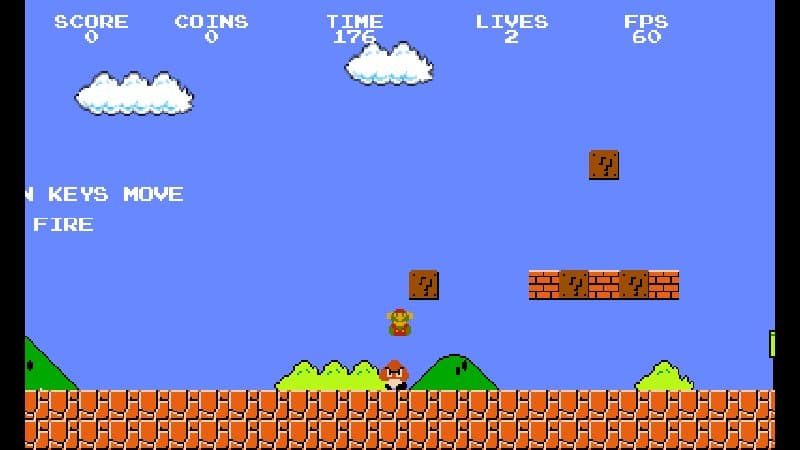
Super Mario Bros. launched in Japan on 13 September 1985. Its very first level, World 1-1, is probably the most studied piece of level design in video game history. It teaches everything the player needs without a single word of text. Several versions on this site recreate it — try the Mario.js remake or the Phaser 3 version while you read.
The first screen
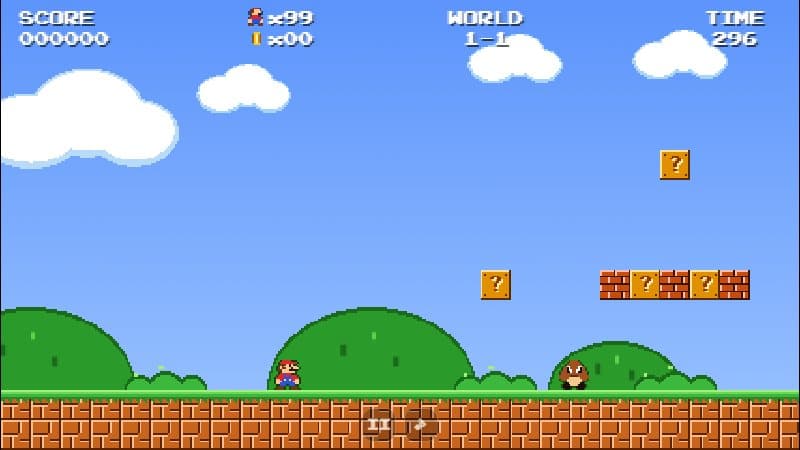
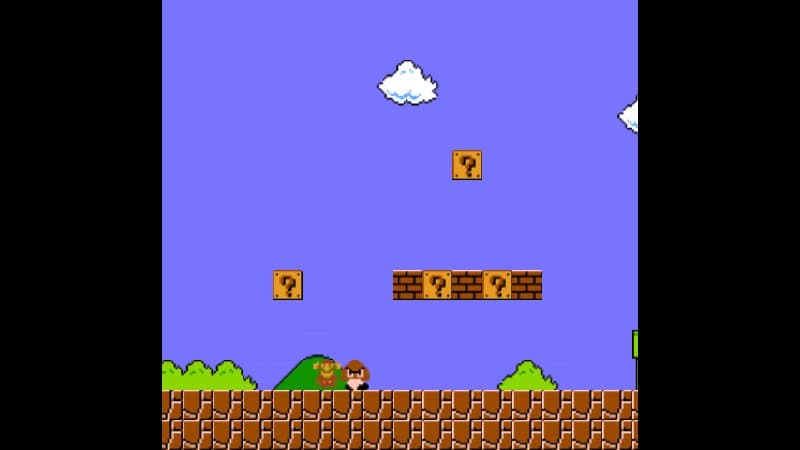
Mario starts on the left of the screen, with lots of empty space to the right. In 1985 many games were static, single-screen experiences; this simple placement says “go right”. The background hill and clouds also help: they move as you walk, showing that the world scrolls.
The first Goomba
Within seconds, a Goomba walks toward you. It looks angry and it is coming straight at you. The player has a few choices: get hit (and learn enemies are dangerous), or press the button and jump. Jumping over it — or landing on it — teaches the most important verb of the game.
The first ? block
Above the first Goomba floats a flashing ? block. Flashing means “interact with me”. Many players jump to dodge the Goomba and hit the block by accident, getting a coin — teaching that blocks can be hit from below and contain rewards.
The mushroom trap
Next is a row of blocks with a Super Mushroom inside. When it pops out, it slides right, hits a pipe and comes back toward Mario. A new player might think it is an enemy and try to dodge it, but the low ceiling of blocks makes that hard. Most players touch it — and Mario grows. The level is designed so you learn power-ups are good, even if you didn't mean to collect one.
Pipes of growing height
A series of pipes follows, growing taller one after another, with Goombas walking between them. The player learns that holding the button makes a higher jump, because the tallest pipes cannot be cleared with a tap.
Secrets for the curious
1-1 also plants the idea of exploration. An invisible 1-Up block waits in the air, a pipe leads to an underground coin room, and a brick hides a Starman. None of them are required — but players who find them learn that the world rewards curiosity.
The staircase and the flag
The level ends with stone staircases and a gap between them, testing everything you've learned in a safe setting. Then comes a tall staircase leading to the flagpole: the higher you grab it, the more points you get. It's an optional skill challenge that also signals the end of the level in an instantly understandable way.
Lessons for designers
- Teach in a safe space, then test with risk. Each new idea appears first where failure is cheap.
- Use the environment instead of text. Placement, movement and colour do the explaining.
- Make accidents productive. The mushroom placement ensures players learn even when they're confused.
- Reward curiosity, don't demand it. Secrets are optional bonuses.
Our own Mario.Game Adventure follows the same structure in its first level, Green Hills: an early power-up row, rising pipes, a hidden 1-Up after a Piranha Plant pipe and a staircase finale.